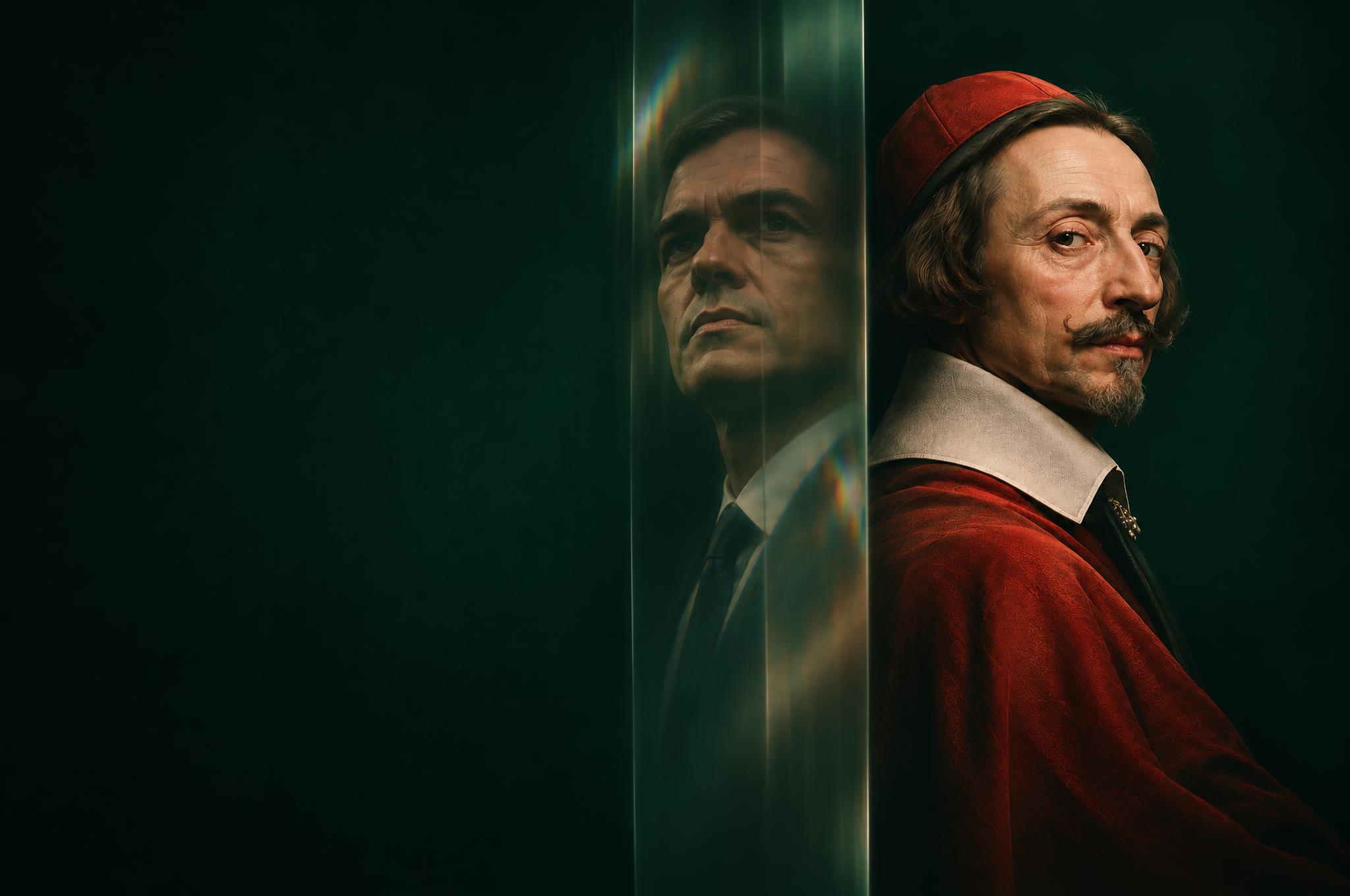
On November 11, 1630, half the French court believed Cardinal Richelieu was finished. The queen mother, Marie de' Medici, had demanded that her son, Louis XIII, dismiss him, and the "devout party" of uncompromising Catholics was already dividing up the spoils. The next day the king stood by his minister, and it was his enemies who went into exile. The episode went down in history as the Day of the Dupes.
What did they hold against him? Something that seemed unforgivable in a prince of the Church: allying with the enemies of his own faith.
IThe present
Pedro Sánchez has governed Spain since 2023 thanks to a highly heterogeneous parliamentary majority:
- the left;
- Basque nationalists;
- Catalan separatists who want to leave the state he leads.
His 2023 investiture rested on an amnesty law for those prosecuted over the Catalan independence bid, passed in 2024. Critics call it the price of power; supporters call it a path to reconciliation.
In November 2025 the relationship with Junts, Carles Puigdemont's party, broke down:
- Junts announced it would vote against all government legislation and against the 2026 budget.
- Congress rejected the government's deficit targets with votes from the conservative PP, the far-right Vox and Junts.
The last budget Sánchez got through was in 2022, covering 2023. Even so, he has repeatedly said he will serve out his term. In August 2026 he said he would present a budget that year and that the general election would come in 2027.
The question dividing Spain is an old one. Can a ruler ally with people who want the opposite of what he wants, if it serves a larger goal? Or does the alliance end up becoming the goal?
IIThe precedent
Armand-Jean du Plessis, Cardinal Richelieu, was Louis XIII's chief minister from 1624 to 1642. His obsession was not religion but French power. The great obstacle was the Habsburgs, who ruled Spain and the Holy Roman Empire and hemmed France in on almost every border.
The Thirty Years' War was in large part a war between Catholics and Protestants. A cardinal's natural place was on the Catholic side. Richelieu chose the other.
In 1624 he allied Catholic France with the Protestant Dutch. His masterstroke came on January 23, 1631, with the Treaty of Bärwalde:
- The deal: France would pay Gustavus Adolphus of Sweden, the great Protestant warlord, 400,000 Reichsthaler a year.
- In return: Sweden would keep an army of 36,000 men in Germany.
- The paradox: the ally was a kingdom where being Catholic was illegal.
Richelieu becomes chief minister
That year he allies Catholic France with the Protestant Dutch.
Richelieu was no believer in tolerance. At home he crushed the rebellion of the Huguenots, France's Protestants, at the siege of La Rochelle (1627–1628). The Peace of Alès (1629) let them keep their worship but stripped them of their fortresses and political power.
His logic had a name: raison d'État, reason of state. The interest of the state came before any other loyalty, religious ones included.
To blunt the criticism, that same year he also signed a pact with Catholic Bavaria. In other words, he funded both sides of his own contradiction.
IIIThe parallel
This is not a comparison of personalities but of a method of governing. There are four recognisable rhymes:
- The impossible ally. Richelieu used French money to back those fighting his Church. Sánchez is kept in office by the votes of parties that want to break up, or deeply distrust, the state he governs.
- The higher end. For Richelieu, stopping the Habsburgs justified everything. For Sánchez, keeping the PP and Vox out of government. Supporters call it strategy; critics call it survival.
- Rebellion in your own camp. The Day of the Dupes was a revolt of Catholics against their own cardinal. Criticism of Sánchez from parts of his own party and traditional electorate rhymes with it, on a different scale.
- The ally you cannot control. Richelieu paid Gustavus Adolphus but did not command him. After his victory at Breitenfeld in 1631, the Swedish king pushed into Catholic Germany with his own agenda. The paymaster discovered that his ally had plans of his own. Junts, with its vetoes, has delivered a similar lesson.
OutcomeThe outcome
Richelieu did not live to see how his bet ended:
- 1632. Gustavus Adolphus was killed at the battle of Lützen.
- 1634. The Swedes were routed at Nördlingen, and many German allies made peace with the emperor.
- 1635. Facing isolation, Richelieu took France into open war with the Habsburgs.
- December 4, 1642. He died in the middle of that war.
Abroad, the bet paid off. The Peace of Westphalia (1648) and the Peace of the Pyrenees (1659) made France Europe's leading power and confirmed Spain's decline. The modern international order, made of sovereign states that ally by interest rather than creed, owes a great deal to his logic.
At home, the price was steep. The war was paid for with crushing taxes that set off peasant revolts, such as the croquants and the nu-pieds of Normandy in 1639. Six years after his death came the Fronde (1648–1653), a rebellion of nobles and courts against the power he had concentrated. His political heir was Louis XIV, and absolutism.
The cardinal won his foreign war, but left behind an exhausted country and a power without checks.
IVWhat has changed
The analogy has limits that must be stated plainly.
Richelieu answered to one man, the king. Sánchez answers to parliament, the courts, the press and, above all, voters. What in the 17th century was settled by exile is now settled by no-confidence votes and elections.
Richelieu's alliances were international and made in wartime. Sánchez's are parliamentary and made inside a constitutional democracy, where deals with distant parties are routine. Coalition governments with awkward partners exist across Europe.
Nor is there anything in today's Spain comparable to La Rochelle or to the absolutism Louis XIV inherited. Pushing the parallel that far would be dishonest.
One more thing. The most famous line attributed to Richelieu, that six lines written by the most honest man would give him enough to hang him, has no reliable source. It is apocryphal, which is worth remembering in an age of easy quotes.
VThe unknown
History judged Richelieu by his results: Westphalia, the Pyrenees, a dominant France. It also judged him by their cost: revolts, the Fronde, absolutism. His reason of state worked because it served a clear, measurable external goal, Habsburg power, and because the awkward ally was a tool rather than an end.
The question for Sánchez, and for whoever governs after him, is whether uncomfortable alliances serve a project that can be measured, or only the government's survival. His supporters will say the former; his critics, the latter.
Richelieu died before he knew whether he had won. Sánchez will find out sooner: the election is due in 2027.
Sources & references
- Ara — El Gobierno español se aboca a agotar la legislatura sin presupuestos
- Diario de Noticias — Junts bloqueará las iniciativas del Gobierno
- Diari de Tarragona — Sánchez agotará la legislatura aunque sea sin presupuestos
- Moncloa.com — Sánchez: presupuestos en 2026 y elecciones en 2027
- Europa Press / Bolsamanía — Sánchez confía en el PNV y espera reconstruir puentes con Junts
- Wikipedia — Treaty of Bärwalde
- Britannica — Treaty of Bärwalde
- Wikipedia — Treaty of Fontainebleau (1631)
- History Learning Site — Cardinal Richelieu
This article was produced with the help of AI tools and checked against the sources cited. Documented facts, interpretations and hypotheses are presented as such.